Testimonios clientes, Empacadoras y apiladores, ERGOSA
QUALVIS supera las 80.000 cajas por hora con la ERGOSA
Qualvis liberó el potencial de rendimiento de su nueva plegadora-encoladora de alta velocidad con la encajadora ERGOSA. Los resultados iniciales de rendimiento superaron su objetivo y alcanzaron velocidades promedio de 75.000 estuches por hora. Los operarios reportan una mejora ergonómica tangible.
EXPERIENCIA DE UN CLIENTE DESTACADO:
Qualvis Print & Packaging: Impulsando el potencial de alto rendimiento
Una empresa familiar británica, especialista en empaques, invierte en su primera solución de encajado semiautomatizada para asegurar una producción a máxima velocidad con su nueva plegadora-encoladora.
Empresa: Qualvis Print & Packaging
Ubicación: Reino Unido
Sector: Empaques para alimentos y cosméticos (estuches plegables)
Solución IMPACK®: Encajadora semiautomatizada ERGOSA con módulo girador de cajas INH
3 veces más rápida |
|
Máximo87.000 |
Promedio 70.000-75.000 |
|
| Aumento de velocidad de la plegadora | Estuches/hora ya alcanzados | Estuches/hora ya alcanzados |
Built on Quality and Service — and Growing Fast
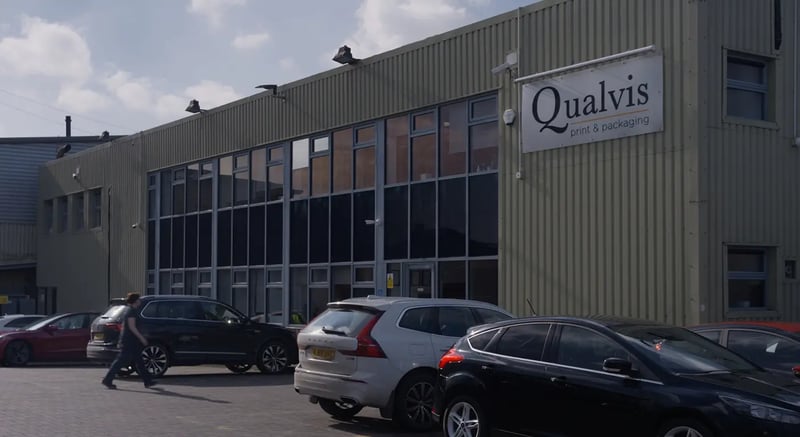
Qualvis ha producido estuches plegables para los sectores de alimentos y cosméticos durante décadas.
Marcus, Codirector General, describe la empresa que su padre construyó desde cero como una empresa familiar que forjó un nicho estratégico para aquellos clientes que buscaban algo diferente a los productos de alto volumen y alternativas estandarizadas.
«Siempre nos hemos concentrado en la alta calidad. De ahí nace el nombre Qualvis: una combinación de calidad y servicio. Esa es la esencia de la empresa».— Marcus Short, Codirector General
Esta esencia ha demostrado ser sostenible. Hoy en día, Qualvis cuenta con una plantilla cuya antigüedad promedio es de unos 13 años. Tan solo en el equipo de acabado, cuatro o cinco personas llevan más de 30 años en la empresa. Algunos de los hijos de estos fieles colaboradores ahora operan maquinaria en la planta.
El desafío: cuando los clientes de toda la vida superan la capacidad de la línea
Volumen de línea recta, a gran escala
A lo largo de 20 años o más, muchos de los clientes leales de Qualvis han crecido de forma significativa. Sus requerimientos de empaque evolucionaron —lo que llevó a Qualvis a buscar nuevas soluciones— desde tiradas pequeñas hacia una producción de estuches a alta velocidad.
«Contamos con bastantes clientes que han estado con nosotros por más de 20 años; y han crecido a la par con la empresa. Sus volúmenes han aumentado a tal punto que el acabado se convirtió en un cuello de botella, debido al intenso volumen de trabajo en línea recta».
— Jordan Pugh, Director de Operaciones y Cadena de Suministro
«Tuvimos que invertir porque nuestra capacidad simplemente había llegado a su límite».
— Marcus Short, Codirector General
La decisión estaba tomada: invertir antes de que la capacidad dictara las condiciones. Jordan y Marcus analizaron las opciones de fin de línea con John Hall, agente de IMPACK en iPack Solutions, quien les propuso la ERGOSA.
El objetivo: alcanzar el potencial de la nueva plegadora.
Al momento de evaluar diversas plegadoras, Qualvis analizó varias máquinas en el mercado. Mientras visitaban a Koenig & Bauer para ver una imprenta, encontraron la respuesta a su volumen de producción en línea recta.
«Casi nos topamos con ella por accidente. Estábamos allí para ver una prensa de impresión. El gerente de ventas de acabados nos mostró una plegadora en desarrollo, nos enseñó su capacidad y, en ese momento nos dijimos: “esto es lo que queremos, esto es lo que necesitamos”».
— Jordan Pugh, Director de Operaciones y Cadena de Suministro
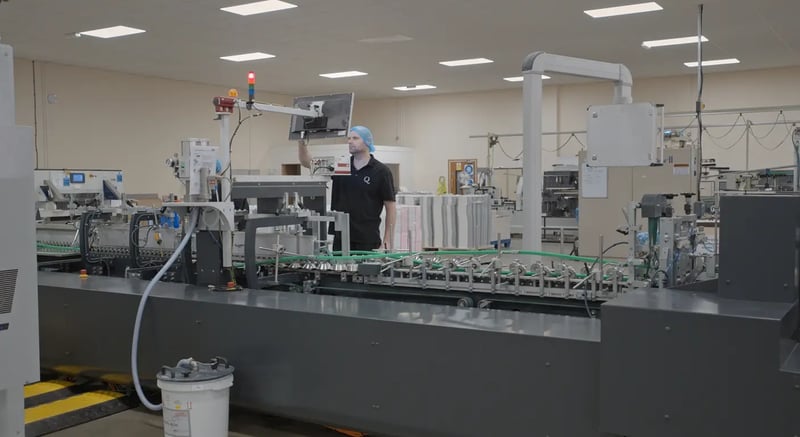
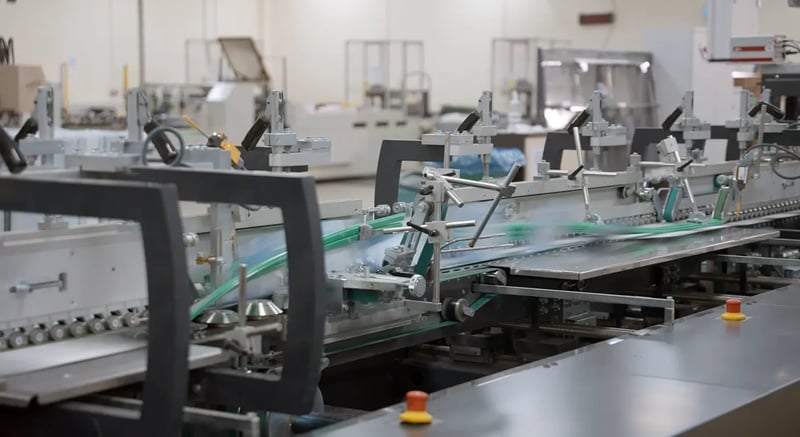
Qualvis fue la primera empresa a nivel mundial en instalar la nueva plegadora-encoladora de línea recta de K&B, diseñada exclusivamente para volumen y velocidad.
El encajado manual al triple de velocidad simplemente ya no era viable.
El método de encajado anterior en Qualvis era manual, con tres personas al final de la plegadora. Una persona gestionaba el flujo de cajas (shingle stream), otra armaba las cajas y mantenía las solapas abiertas, mientras que la tercera cargaba los estuches, levantando lotes y girando 90 grados repetidamente durante todo el turno.
El encajado manual ya limitaba la producción; la velocidad triplicada habría hecho que el potencial de la nueva máquina fuera totalmente inalcanzable.
«Con esta nueva máquina, estamos yendo al triple de velocidad. Hubiera sido imposible mantener el ritmo No queríamos limitar la velocidad de la máquina, por lo que había que facilitar el trabajo de los empleados al fin de línea».
— Marcus Short, Codirector General
La solución: ERGOSA — la decisión acertada
Una transición estratégica hacia la automatización
Qualvis evaluó opciones de encajado totalmente automatizadas. Por ahora es algo que podrían considerar en el futuro. Pero para esta inversión —su primera incursión en el encajado automatizado de fin de línea— el salto total a la automatización se pospuso hasta contar con un punto de referencia sólido.
La encajadora semiautomatizada ERGOSA ofrece un punto medio ideal: capaz de soportar las velocidades requeridas, y lo suficientemente flexible para su gama de productos; representa un alivio para un staff que hasta entonces solo había empacado a mano.
«Estuvimos cerca de elegir el encajado totalmente automático. Pero pasar del encajado manual directamente al automático hubiera sido un salto bastante grande. La ERGOSA ofrece un punto medio excelente, permitiéndonos aun así operar a velocidades muy altas».
— Jordan Pugh, Head of Operations & Supply Chain
"The ERGOSA has come with such great credentials. A lot of our competitors have used them. We looked at them in the past and it just seemed the right choice for the right time."
— Marcus Short, Joint Managing Director
Flexibility built in from the start
Qualvis' production environment requires flexibility. A single carton design can run for three or four days — or it can change three or four times a day. The ERGOSA's quick changeover and multi-configuration capability means it adapts to both scenarios without compromise.
While 95% of the work on the new line will likely be single-row, single-layer packing, the ability to run more complex case configurations when needed was a key selection criterion.
"Having the option for the 5% — to be able to do much more complex packing — is a real highlight."
— Jordan Pugh, Head of Operations & Supply Chain
The INH box-turner: Compact, clean, practical
Qualvis produces primarily food packaging, where a physical marker on the carton is not an acceptable solution for tracking reject product. The integrated INH box turner maintains the kick-out carton ensuring accurate batch counts.
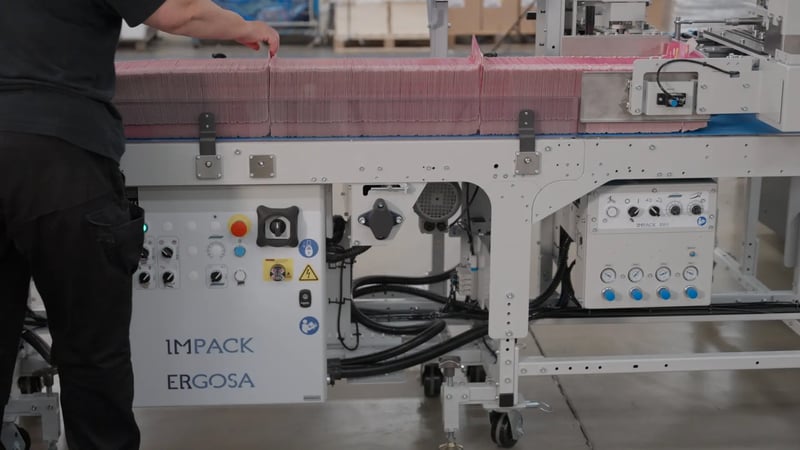
Space was also a factor. The new folder-gluer is 29 meters. Adding a packer at the end requires careful thought regarding the layout. The ERGOSA INH configuration is more compact than alternatives, leaving room for case sealing before being routed to the palletization zone.
"Even though we're blessed with quite a lot of space compared to others, having the packer slightly shorter has definitely helped. We're going to need more space to put work down there now — so having it as a more compact configuration has really allowed us to get that."
— Jordan Pugh, Head of Operations & Supply Chain
Watch how the Qualvis team reaches speeds over 87,000 cartons per hour.
Speed, Ergonomics, and Operator Confidence
Throughput: Ahead of target
Qualvis set an internal benchmark of 60,000 cartons per hour across their five main lines. The ERGOSA combination has already seen output reach 75,000 cartons per hour — and the line has demonstrated it can go further.
"We're hoping for above 60,000 cartons an hour. We had it running at 75 already for a short while, and it seems capable of doing that. Anything above 70 would be great."
— Jordan Pugh, Head of Operations & Supply Chain
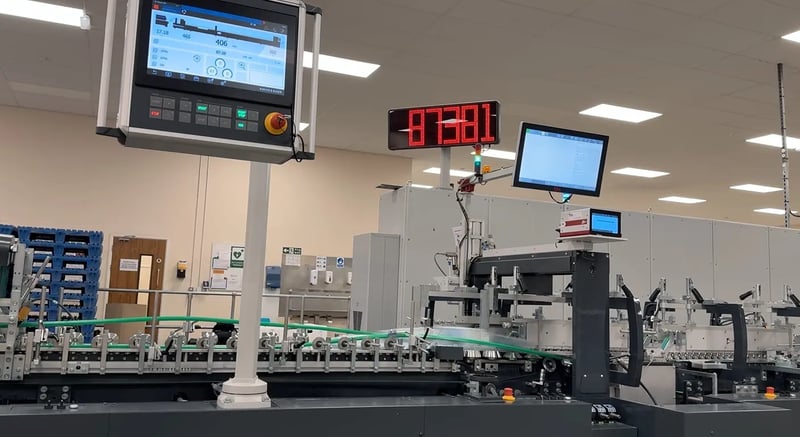
The screen on the Koenig& Bauer folder-gluer shows a speed of 87,381 cartons per hour.
Ergonomics: Real relief for the finishing team
The impact on the packing team has been immediate and visible. Operators no longer need to rotate or reach across the line. The physical workload is reduced; the rhythm of the work is more natural. For a company that retains staff for an average of 13 years and counts multi-generational families among its workforce, the ergonomic improvement is not just operational. It reflects the values Qualvis has built its culture on.
"There are a few people down there with wrist splints and arm sleeves. Hopefully the ERGOSA is going to eliminate all of that and allow people to be a lot more comfortable. It's not heavy lifting, but it's the repeatability — a lot of the same motion, twisting, picking up boxes. They're not doing that anymore."
— Jordan Pugh, Head of Operations & Supply Chain
Operator adoption: Faster than expected
Packing by hand for years creates deeply embedded habits, but Jordan says adoption has been faster than anticipated. IMPACK trainer Raphaël Desmarais delivered hands-on training, and was credited by Jordan for the team's confidence.
"The packing team has been very excited about the investment. The trainer we've had on site has been really good — really welcoming. He's helped the team adapt to the machine slowly and carefully, and that's made a real difference. The vast majority have picked it up straight away. Even after a couple of days of training, they seemed very comfortable."
— Jordan Pugh, Head of Operations & Supply Chain
The current plan is to maintain two operators on the end of the packer at high speeds — one managing carton transfer into the case and conducting quality checks and the other erecting cases and applying labels. At lower speeds, one operator will be sufficient.
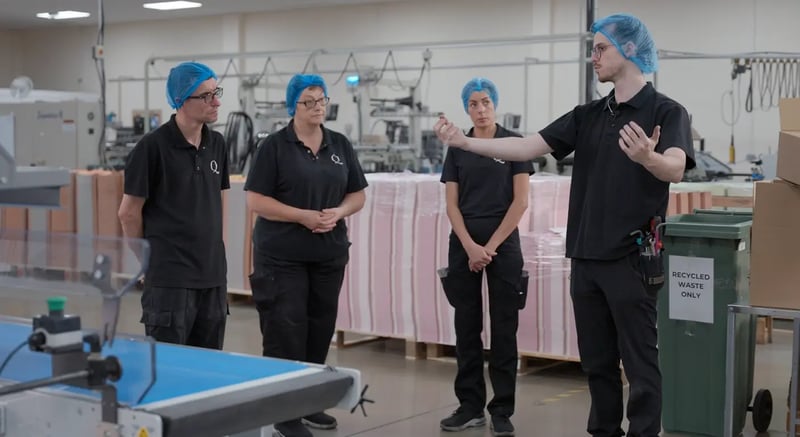
IMPACK trainer Raphaël Desmarais explains packing best practices to the Qualvis packing team.
A Partnership Built on Access and Transparency
Marcus highlighted the working relationship with John Hall of iPack Solutions as a meaningful part of the experience that built confidence before the purchase.
"The experience has been great, working predominantly with John Hall and the iPack Solutions team. They've been very attentive. They managed to get us into some of our competitors, which shows they've got a really good working relationship. Those companies were happy to let us through the door and show off the machine."
— Marcus Short, Joint Managing Director
"The Qualvis team has been a delight to work with on this project, bringing a collaborative spirit and genuine enthusiasm that made the entire installation process seamless. Their operators embraced the change with impressive speed, and the support from Marcus, Jordan, and the whole team reflects the quality-driven culture that defines their business."
— John Hall, Managing Director
What's Next
Qualvis is clear that their automation journey is just beginning. The modular architecture of the ERGOSA means that it can evolve with their production.